On 24 June 2025, the Supreme Court issued its long-awaited decision in the trade mark infringement case Iconix v Dream Pairs with Iconix (the owner of Umbro) losing its appeal against value footwear brand Dream Pairs over a logo that was argued to be "confusingly similar" to Iconix's trade marked double diamond. This dispute raises important considerations around registered trade mark protection in the UK and the basis upon which similarity of signs and consumer confusion may be assessed.
Background
As a recap, the infringement of a UK registered trade mark may occur where it can be proven that there is a (a) degree of similarity between the registered mark and the allegedly infringing mark and (b) this similarity is likely to lead to confusion on behalf of the average consumer.
In 2023, Iconix raised an action in the High Court of Justice against Dream Pairs in respect of the sign which it was using on football boots, which it claimed infringed Iconix's registered trade marks in the shape of a double diamond, frequently featured on footwear and clothing.
Here are Iconix's trade marks and Dream Pairs' logo, as referenced in the Supreme Court judgement:
Iconix's trade marks:
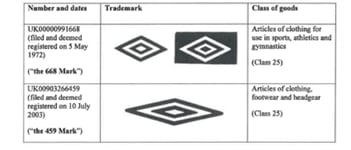
Dream Pairs' logo:

Trade mark infringement was claimed by Iconix on the basis that the use of Dream Pairs' logo:
- gave rise to a likelihood of confusion with the double diamond shape; and
- took unfair advantage of, or was detrimental to, Iconix's trade marks.
The claim was dismissed at first instance on the basis that the logos were not sufficiently similar to cause visual confusion. The judge noted that although both logos were of similar shapes and angles, they had a "very low degree of similarity" and in any case, Umbro (via Iconix) had established distinctiveness via extensive use.
The case was appealed to the Court of Appeal, where the High Court's decision was overturned. Whilst the appellant court supported the notion that there may only be a faint similarity when the logo is viewed solely as a graphic image, it found that when the logo is viewed from a different angle there is a heightened degree of similarity. Specifically, the Court of Appeal found that a person viewing the logo on footwear for the first time in a post-sale context would likely be viewing from head height on someone else’s foot – an angle which would foreshorten the logo, altering its angle. It was held that this view of the logo heightened the similarity to a degree that could induce confusion on behalf of the average consumer. Dream Paris appealed to the Supreme Court.
Decision
The Supreme Court has now found in favour of Dream Pairs, holding that its use of the logo does not infringe Umbro’s “double diamond” trade marks. Crucially, the Supreme Court held that the Court of Appeal was not entitled to substitute its view of the similarity and confusion assessments for that of the trial judge at first instance
However, the Supreme Court did accept Iconix's arguments that post-sale circumstances may be taken into account when assessing the similarity of a mark for the purposes of determining trade mark infringement, and that trade mark infringement may occur in post-sale contexts even when confusion on the part of the average consumer does not extend to future points of sale.
Setting aside the surprising comments made about the Court of Appeal, the decision provides a useful insight into the assessment of trade mark infringement in a post-sale environment and is helpful to brand owners in that regard.
If you have any queries, please contact one of our intellectual property solicitors.