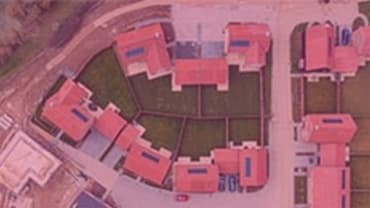
Buying land for residential development in Scotland can involve site assembly, i.e., piecing together parcels of land which will make up the new development, including land for roads, pavements, parking, green areas, substations as well as the new homes to be built. This will involve identifying the owners of the land incorporated within the site (see our blog on tracking ownership) and then negotiating the purchase of the land or acquiring the necessary rights over adjoining land. The challenge is to ensure that there are no holes or gaps in the composite site and that the different pieces can be bought as and when they are needed for development to begin and progress.
Making sure that all sellers have been identified
The size of the site does not dictate the number of owners. City centre sites, often restricted in size due to neighbouring development, can be the most difficult to assemble. For example, buying a site which once hosted tenement flats could mean buying from each of the individual owners of the former tenement. That is even the case when the tenement has been demolished as former owners may still own the slice of airspace their flat once occupied. If the former owners of a tenement can’t agree on a sale, a court order may be needed to allow development to go ahead.
On the outskirts of town larger sites may be owned by one or two parties. However, sometimes more detailed investigation can throw up some unexpected, curve balls in terms of the extent of titles actually owned by the potential sellers. It is not unheard of for third parties to come out of the woodwork as owners of part of the site. Those third parties may not own large parts of the proposed development site, but they may own slivers at the edges or parts in the middle. This can result in developers revisiting and amending plans to carve out areas or, alternatively, seeking to negotiate with those third parties.
Making sure it fits together
Ownership titles to land in Scotland are registered in two registers, the older Sasines Register and the newer Land Register of Scotland. The titles to land still in the Sasines Register will not always have a title plan and the extent of the land owned by the seller may be unclear. The titles in the Land Register will have a title plan which is guaranteed by Registers of Scotland. However, mistakes must be checked for. The boundaries of all parcels of land making up the site must marry up – there must be no gaps.
Any gaps could be owned by third parties who may see it as a ransom situation from which they can profit if the gap is needed for part of the development or for access purposes. On the other hand, the owner may not be traceable and other steps may need to be taken– see our blog on where ownership cannot be traced.
Making sure there are no unexpected occupiers
The Sasines and Land Registers will not contain details of any shorter leases, for example, grazing leases or leases for car parking or substations which may have been granted to third parties. Development sites don’t just need the land that the homes are built on, they also need access for pipes and cables to service the homes. Negotiations with the owners of the land must flush out any occupiers or existing services which could block development or mean that site plans must be changed and services diverted.
If any leases have been granted to third parties, the seller will have to undertake to end those leases and provide the buyer with vacant possession. This may require adjustments to timings depending on the type of lease and the terms of the lease. For example, there may be more to a grazing lease; it could have become a short-term agricultural lease which may take longer to bring to an end.
The Sasines and Land Registers will not contain details of any wayleaves (contracts) for utilities. Asking utility providers to lift and shift existing equipment can be a time consuming and costly process, even if a contract provides for lifting and shifting.
Making sure the contracts are coordinated
Having identified the owners and the relevant persons to negotiate a purchase, care must be taken to ensure that the contracts to buy the land are coordinated – a buyer does not want to buy in one site without knowing that purchase of the other site will also complete at the time needed for development timings to be adhered to. This can be a difficult process to manage as it may be the case that each contract is to be dealt with confidentially - they cannot be disclosed to the neighbouring owner and cannot be conditional on the other progressing to completion.
Completing the site assembly
Having coordinated the contracts, completing the purchase of the site must be handled carefully. The contracts are likely to be options to buy or conditional contracts which will only require the purchaser to proceed with the acquisition if and when they get planning permission or funding in place to their satisfaction. They may also be conditional on the sellers bringing leases and licences to an end and securing vacant possession of their land.
In the case of larger sites, there may be staggered completions where different parts of the site are being bought at different times to aid cash flow and align with phased development plans. If the contracts are conditional on planning permission being obtained, the developer must monitor the progress of the planning application and ensure that any notices to complete the sale are served correctly and on time.
If the whole site is purchased simultaneously, it will be possible for the purchasers to request that Registers of Scotland merge the titles and produce the same title number for all constituent parts. This can make the process of applying title conditions to preserve rights in favour of the developer and protect amenity of the development and the onward sale of plots more straightforward.
The above is a high-level look at some of the issues and challenges which need to be addressed when piecing a development site jigsaw together. Please contact your usual Brodies contact if you would like more detailed advice or information.
Part 1: Tracking ownership of land in Scotland
In the first blog of our series, we explore how to track land ownership and identify potential issues before development begins.
Read now
Part 3: Conditional contracts and option agreements
In part three of our series, we consider how conditional contracts and option agreements work in practice and what buyers and sellers need to think about.
Read nowGet in touch
Our specialist lawyers are on hand to help you with every stage of the housebuilding process.
Get in touchContributor

Director of Knowledge (Real Estate)